

Why Autonomous Security Needs to Be Sovereign
An AI security agent investigating a vulnerability may need to inspect source code, analyze application behavior, query security systems, execute tests, and initiate remediation through a development pipeline.
Giving an agent permission to analyze code is very different from allowing it to modify code, access production systems, or trigger a deployment.
Enterprises need to make these decisions themselves, particularly when agents have access to sensitive systems. Where does the agent execute? Which systems can it access? What information can it share? Who authorizes its actions?
For telecommunications providers, financial institutions, critical infrastructure operators, and other regulated enterprises, these questions determine whether autonomous security can be adopted within existing security and governance requirements.
Aptori brings AI-powered security into enterprise-controlled environments, allowing organizations to retain control over the infrastructure and processes involved in securing their applications.
Sovereignty is not simply where AI runs. It is who controls what AI can access, decide, and execute.
Sovereignty Goes Beyond Data Residency
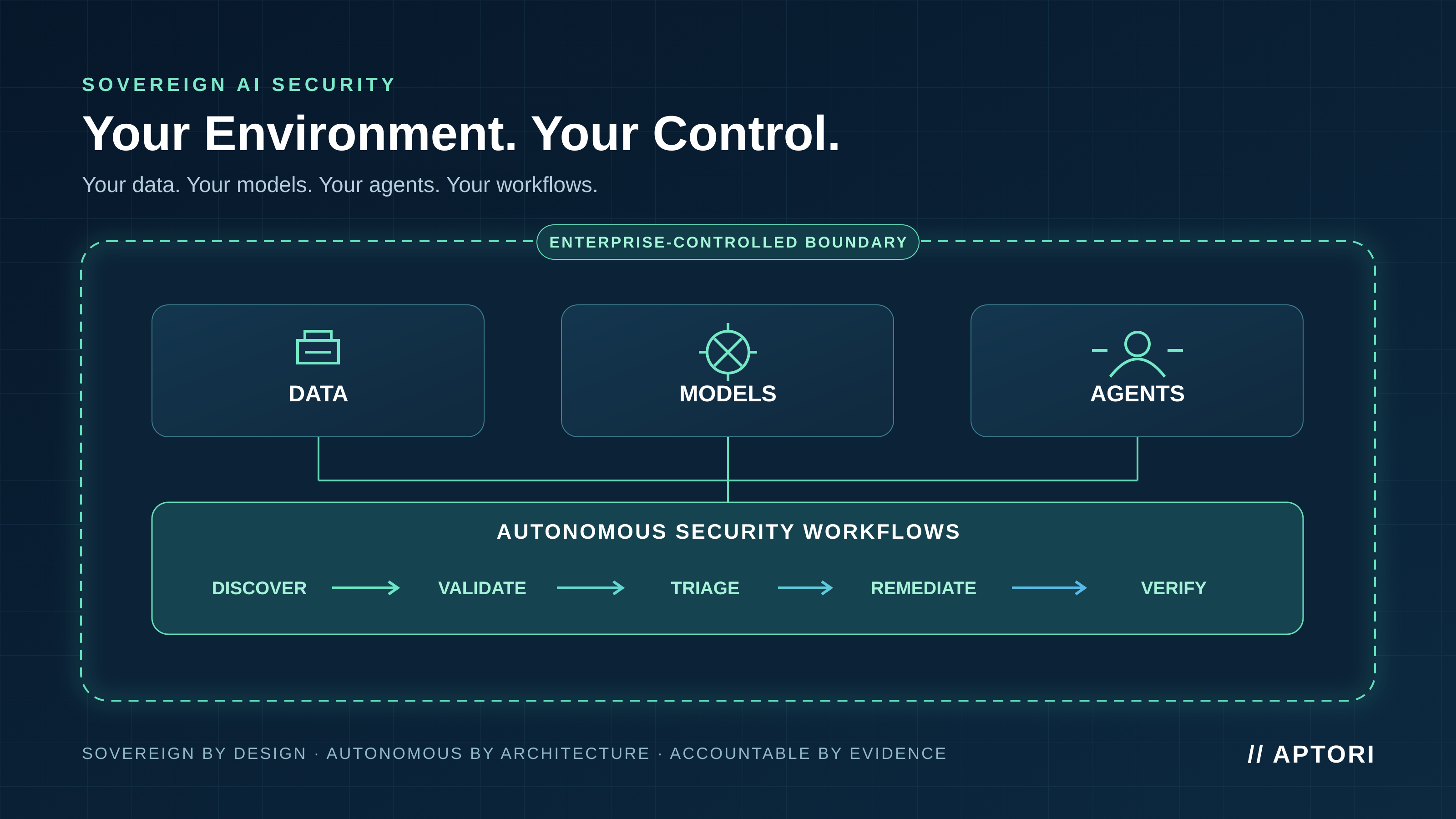
Data residency addresses where information is stored and processed. Sovereign AI security goes further, encompassing control over models, agents, permissions, and the workflows they execute.
Aptori supports self-hosted deployment on enterprise-managed Kubernetes infrastructure, including isolated environments, as well as dedicated single-tenant SaaS deployments.
In a self-hosted architecture, Aptori's security engines and orchestration capabilities run within the customer's infrastructure. Source repositories, application specifications, security telemetry, and analysis results can be processed within approved enterprise boundaries.
Organizations can connect the platform to privately hosted AI models, including models served through vLLM or Ollama. This allows model selection to reflect internal security policies, performance requirements, and operational constraints rather than dependence on a single external provider.
In practice, that means controlling four things::
- Data: Where source code, telemetry, findings, and security evidence are processed and stored.
- Models: Which AI models are used, where they execute, and how they are accessed.
- Agents: Which systems agents can access, which tools they can invoke, and what actions they are authorized to perform.
- Workflows: How security tasks are coordinated across existing systems, including approval requirements and escalation policies.
Self-hosting alone does not guarantee sovereignty. External model endpoints, integrations, and data transfers must also comply with the organization's policies.
The important architectural choice is that enterprises can deploy and configure these capabilities within their established security boundaries.
Building Agents Around Existing Security Operations
Most enterprises already have the tools needed to discover vulnerabilities, manage development, and track remediation. What is often missing is a reliable way to connect them.
A finding in a scanner still needs to become a validated issue, an assigned fix, and a successful retest.
Aptori connects these activities through semantic application analysis, autonomous runtime testing, and tailored AI agents that work with existing security and development systems.
Consider an authorization vulnerability in an API.
Aptori SMART analyzes the source repository and constructs a semantic representation of the application, including routes, functions, call relationships, data flows, and relevant security boundaries. This context helps identify how a potentially vulnerable operation can be reached and which application components influence its behavior.
A static finding alone cannot always establish whether an authorization weakness is exploitable. Aptori's semantic runtime testing exercises the relevant API operations and application workflows, including stateful sequences involving users, resources, and authorization boundaries.
For example, testing can determine whether a user can access or modify a resource belonging to another account. The result is behavioral evidence that helps distinguish an exploitable vulnerability from a finding that has not demonstrated practical impact.
Once validated, a tailored security agent can coordinate remediation through existing enterprise systems. It may create an issue in Jira or ServiceNow, generate a proposed code fix, or initiate a pull request for developer review.
These actions operate through configured integrations and authorized tool interfaces. An organization may permit an agent to propose a patch but require a developer to approve the change before it is merged. Access to production systems or deployment operations can remain subject to separate permissions and approval policies.
After the fix is applied, the relevant security tests can run again to verify whether the vulnerability has been resolved. The original finding, validation results, remediation activity, and retest evidence can be associated with the same security issue.
The workflow closes when the fix has been verified, not when a ticket has been created.
This approach allows enterprises to automate more of the security process without giving agents unrestricted authority over development or production environments.
Continuous Assurance for EU CRA and UK TSA
The EU Cyber Resilience Act (EU CRA) establishes cybersecurity requirements for products with digital elements, including vulnerability handling and security maintenance obligations. Its main cybersecurity requirements become applicable in December 2027, while specified reporting obligations began applying in September 2026.
The UK's Telecommunications (Security) Act (UK TSA), together with its supporting regulations and Code of Practice, establishes security obligations for public telecommunications providers.
Organizations need evidence showing which vulnerabilities were identified, how they were addressed, and whether the fixes worked.
Aptori's security workflows generate technical records that can support these assurance requirements.
Code analysis and dependency assessment identify potential weaknesses. Runtime testing provides evidence of application behavior and exploitability. Remediation workflows track corrective actions, and subsequent testing records whether the identified vulnerability has been resolved.
For an organization preparing EU CRA technical documentation, these records can provide supporting evidence of vulnerability identification, assessment, and remediation activities.
A telecommunications provider operating under the UK TSA framework can use continuous security testing and remediation records as part of its broader security risk management and assurance processes.
Aptori can map relevant technical findings and testing evidence to applicable security controls and regulatory requirements, helping teams maintain traceability between identified risks, corrective actions, and verification results.
This evidence does not, by itself, establish regulatory compliance. Organizations remain responsible for the broader governance, risk management, documentation, and reporting obligations required by the applicable framework.
For enterprises operating in sovereign environments, security testing and the resulting evidence can remain within approved infrastructure and data governance boundaries.
Making Autonomous Security Work in the Enterprise
Aptori combines semantic code analysis, runtime validation, autonomous penetration testing, and tailored security agents within an architecture enterprises can operate and govern themselves.
Security teams can run the platform in their own infrastructure, use privately hosted models, and connect agents to existing development and security systems. Agent permissions and approval policies determine which actions can execute automatically and which require human intervention.
The objective is to move beyond vulnerability detection to workflows that validate findings, coordinate remediation, and verify fixes while keeping sensitive security operations under enterprise control.
Explore Sovereign AI Security with Aptori
Learn how Aptori can help your organization deploy autonomous security within your infrastructure and integrate tailored agents into existing security workflows.
Take control of your Application and API security
See how Aptori’s award-winning, AI-driven platform uncovers hidden business logic risks across your code, applications, and APIs. Aptori prioritizes the risks that matter and automates remediation, helping teams move from reactive security to continuous assurance.
Request your personalized demo today.


.svg)
.svg)


